 en
en Slovenščina
 Italiano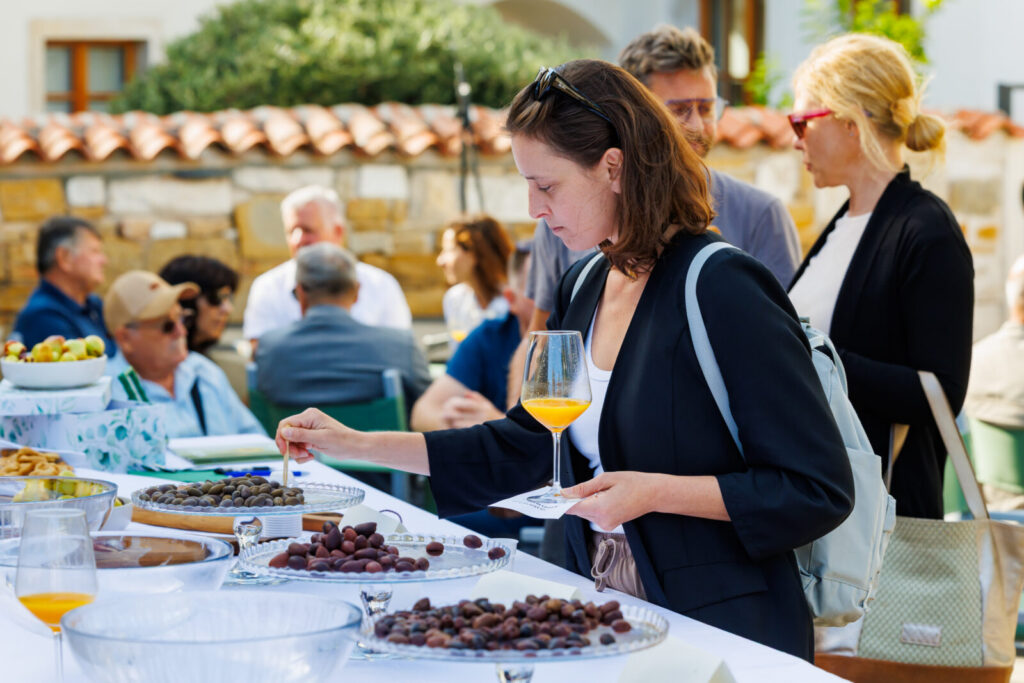
The oldest evidence of table olive preparation dates back approximately 6,700 years. At the submerged Neolithic archaeological site of Hishuley Carmel, off the eastern Mediterranean coast, archaeologists discovered two stone structures containing large quantities of olive pits. A comparison with the nearby Kfar Samir site revealed that these structures were not used for olive oil production but rather for preparing olives for consumption. This represents the earliest archaeological evidence discovered to date of olive processing for use as table olives. Today, Hishuley Carmel lies below sea level, as the Mediterranean Sea was approximately five metres lower when the site was inhabited.
Researchers believe that people were already taking advantage of the proximity of the sea to remove the bitterness from olives during the Neolithic period. The fruits were most likely left to mature in seawater or preserved using sea salt. During this natural process, the bitterness of the olives decreases, while their characteristic flavour and aroma develop. Experiments have confirmed that seawater and sea salt were effective methods of preparing edible table olives thousands of years ago.
From the eastern Mediterranean, olive cultivation gradually spread along maritime trade routes to the northern Adriatic. The earliest reliable archaeological evidence of olive cultivation in present-day Slovenian Istria dates back to the Roman period (1st–5th centuries AD). During this time, numerous olive groves, olive oil mills and ports for the olive oil trade were established.
Olive cultivation in Istria survived the fall of the Western Roman Empire and continued throughout the Middle Ages. When Koper, Izola and Piran came under the rule of the Republic of Venice in the late 13th century, olive oil became one of Istria’s most important economic commodities. Its significance is also documented in the 14th-century work Descriptio provinciae Italiae, which describes Istria as “most fertile in wine and oil”.
During the 19th and 20th centuries, olive cultivation was severely affected by devastating frosts and other economic changes, resulting in a substantial decline in the number of olive groves. Their restoration began after 1985, and today, alongside the production of premium-quality olive oil, the tradition of preparing table olives is once again gaining prominence.
The Tradition of Table Olive Production
Freshly harvested olives are bitter and astringent, making them unsuitable for direct consumption. They must first undergo a debittering process.
In Slovenian Istria, a traditional preparation method has been preserved over the centuries. The olives are initially soaked in water for several days and then left to mature in brine. The entire process usually takes between six months and one year, depending primarily on the olive variety, the ripeness of the fruit and the course of fermentation. Despite the development of modern technologies, this remains the most widely established method of preparing table olives.
Today, traditional knowledge is complemented by professional efforts to preserve it. An important milestone was the development of the Specification for Slovenian Istrian Table Olives with Protected Designation of Origin, initiated by the Štorta Piran Olive Growers’ Association in cooperation with experts from the Institute for Oliveculture at the Science and Research Centre Koper (ZRS Koper).
In 2008, regulations concerning the protected designation of origin were also adopted at the national level. The specification defines the geographical production area, permitted varieties, cultivation and processing methods, quality requirements and product traceability.
Another important element of Istrian heritage is Piran Salt, whose production has a tradition spanning more than a thousand years. In 2014, it was entered into the European Union’s register of protected designations of origin, recognising its unique characteristics, which are based on traditional production using petola, a thin biosedimentary layer of microorganisms and minerals, in the Sečovlje and Strunjan salt pans.
High-quality salt was one of the key factors in the development of table olive production in the region.
Traditional Istrian olive varieties particularly suitable for processing include Štorta, Istrska belica, Buga, Mta and Žižula. These varieties are characterised by appropriately sized fruits, a favourable flesh-to-pit ratio and the ease with which the pits can be separated from the flesh.
In 1913, the agronomist Carlo Hugues wrote about the Štorta variety (Oliva Storta di Pirano) in his work L’olivicoltura nell’Istria, highlighting it as one of the most suitable varieties for preservation. More than a century later, Štorta remains a symbol of table olive preparation in Slovenian Istria, and its potential is also being studied by the Institute for Oliveculture at ZRS Koper.
The Festival Preserves Heritage and Promotes Quality
Preserving tradition involves not only cultivation and processing but also quality assessment.
Today, table olives are evaluated by trained sensory panels using a standardised methodology established by the International Olive Council (IOC), ensuring objective and internationally comparable results.
Samples are assessed anonymously under standardised conditions, with experts evaluating their aroma, flavour, texture and any potential sensory defects. This makes it possible to reliably distinguish premium-quality table olives from products with shortcomings and to maintain high quality standards.
In addition to professional sensory assessment, guided tastings also play an important role, allowing visitors to discover different olive varieties and methods of table olive preparation.
While a professional sensory panel determines whether a product is of high quality and free from sensory defects, consumers primarily judge whether they enjoy its taste.
Bringing together professional quality assessment and consumer experiences is one of the key missions of the Table Olive Festival, which has contributed to the recognition and preservation of this important Istrian heritage for a decade.
This year’s festival will take place on 11 September at Circolo in Koper, where table olive producers will present their products to the general public. An accompanying photographic exhibition will tell the story of the millennia-long history of table olives.
This article was produced within the framework of the research programme Sredozemske kmetijske prakse in družbe v prilagajanju okoljskim spremembam (P5-0453), led by Dr Jerneja Penca, and Javne službe iz oljkarstva, headed by Dr Maja Podgornik.
The research programme is supported by the Slovenian Research and Innovation Agency (ARIS).

- Source: Delo
- Author: Dr Maja Podgornik, Head of the Institute for Oliveculture at ZRS Koper
- Date of publication: 22 September 2026
- Publisher: Delo mediji d.o.o.