 en
en Slovenščina
 Italiano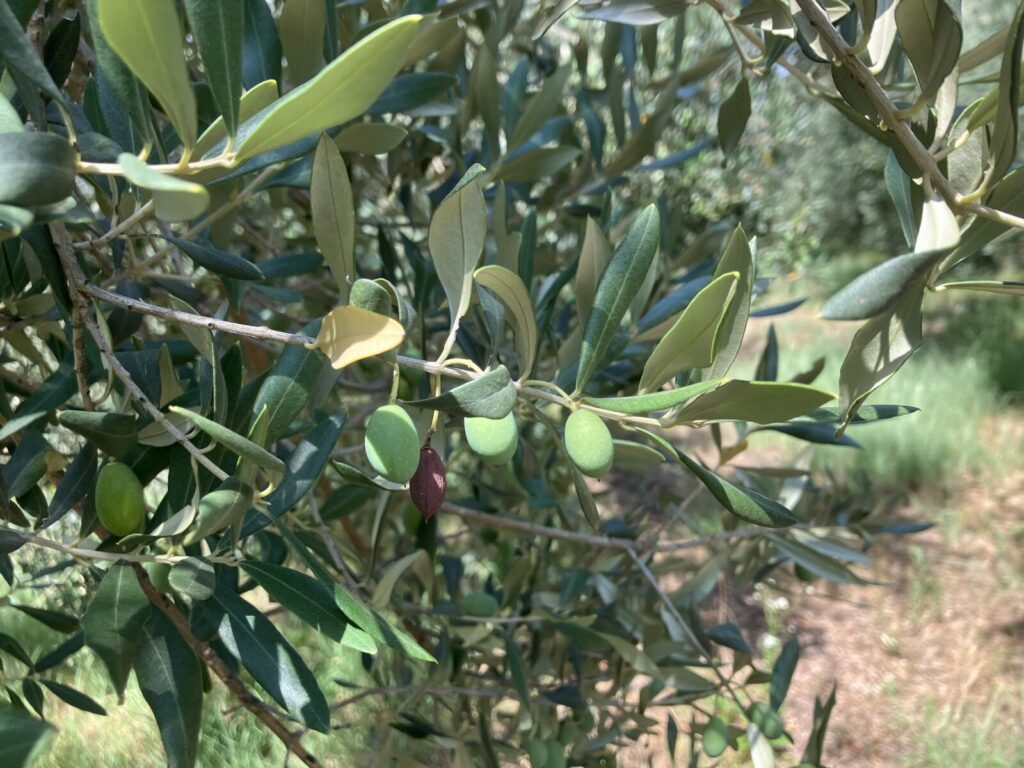
Over the past few years, the same questions have been raised among olive growers every summer. Why are the fruits dropping? Is the heat to blame? A lack of rainfall? The brown marmorated stink bug? Fungal diseases?
In reality, none of these factors is usually the sole cause. They often act only as a tipping point. Whether a tree is able to overcome the stress or begins to lose its fruit largely depends on its physiological condition, which is shaped several months in advance.
A tree in good physiological condition has sufficient leaf area, a well-developed root system, and adequate reserves of water, nutrients and carbohydrates. Such a tree can continue to supply developing fruits even during a short period of drought or a heatwave. The situation is very different in a tree that was excessively burdened by a heavy crop in the previous year or suffered from drought, nutrient deficiencies, disease or other stress factors. It enters the new growing season with lower energy reserves and is therefore much less able to cope with additional stress.
Inflorescence development begins approximately two months before flowering, while the floral organs are fully formed two to three weeks before flowering. For this process, the tree relies almost entirely on reserves accumulated during the previous growing season.
The olive tree produces an exceptionally large number of flowers – a mature tree can develop around 500,000. This is not accidental, but an evolutionary adaptation that increases the likelihood of successful pollination and fertilisation. Nevertheless, by harvest time only around 1–2% of the flowers develop into fruit. Most are shed through natural fruit thinning, a process by which the tree adjusts the number of fruits to its available resources and physiological capacity.
A tree may appear completely healthy from the outside, while its physiological condition may already be compromised by unbalanced fertilisation, reduced leaf area (for example due to peacock spot), wood diseases or other stress factors. As long as conditions remain favourable, these limitations often go unnoticed. However, when heat and drought occur during the most sensitive stage of fruit development, water shortage causes the stomata to close, photosynthesis declines and, consequently, fewer sugars are available for fruit development.
Developing fruits can also be further affected by harmful organisms. Fungal infections may contribute to premature drying and fruit drop, as can damage to the developing seed caused by the feeding activity of the brown marmorated stink bug, particularly before pit hardening.
When the available resources are no longer sufficient to support the development of all fruits, the plant triggers natural fruit thinning through hormonal signals. Fruits resulting from unsuccessful fertilisation, or those with damaged or poorly developed embryos, are more likely to drop, while the plant redirects its remaining resources towards the development of healthy fruits.
However, not all fruits have the same chances from the very beginning. At first glance, olive flowers appear almost identical, but there is an important difference between them. Some are perfect, or bisexual, flowers. These have developed stamens and a normal ovary containing ovules, and can therefore develop into fruit following successful fertilisation. Others are functionally male flowers, in which the ovary is underdeveloped or aborted. Such flowers still release pollen, but cannot develop into fruit.
The proportion of functionally male flowers is primarily a varietal characteristic. Some cultivars, such as ‘Oblica’, develop a substantially higher proportion of functionally male flowers than others. Their proportion is also significantly influenced by the physiological condition of the tree and by weather conditions during flower bud development.
Because a low proportion of perfect flowers could in itself explain reduced yield, this was the first aspect we examined at the Institute for Oliveculture of ZRS Koper within the framework of the public service for olive growing. Four years of monitoring the ‘Istrska belica’ cultivar at three representative locations in Slovenian Istria showed a very high proportion of perfect flowers (75–93%). This indicated that, for this cultivar, it was no longer reasonable to look for the cause of the subsequent reduction in yield in flower quality, but rather in the next developmental stage – after fertilisation.
Following successful fertilisation, the seed develops from the ovule, with the embryo forming inside it. The seed is enclosed by the developing pit. In a healthy fruit, the embryo develops normally. In some fruits, however, embryo development may stop due to abiotic factors such as heat, drought and nutrient deficiency, or biotic factors such as diseases and pests, even though the fruit continues to grow externally. The pit and the flesh may continue to develop normally, so such a fruit generally cannot be distinguished from a healthy one without cutting it open or carrying out an anatomical analysis.
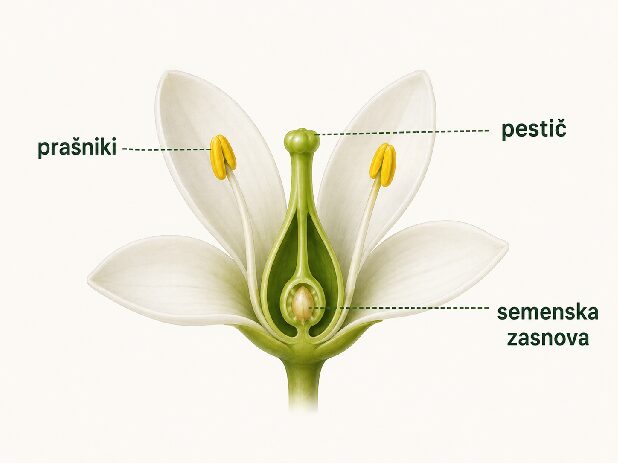
Figure 1 – Flower structure
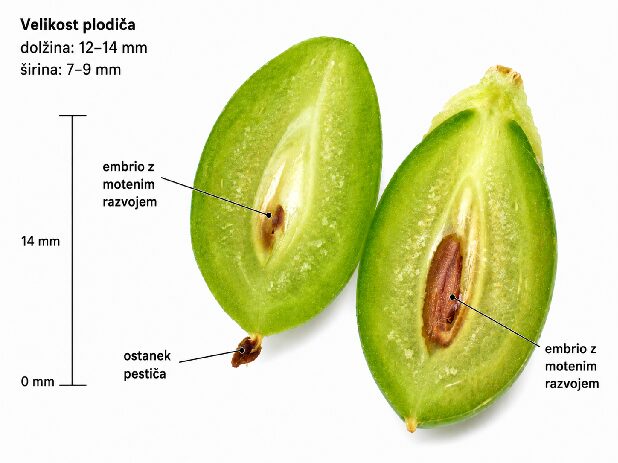
Figure 2 – Cross-section of a young fruit
This is precisely why we focused our research on embryo development. We wanted to determine at which stage of development the damage begins to occur, how it is related to weather conditions, and whether its incidence can be reduced through timely agronomic measures.
An analysis of meteorological data for Slovenian Istria for the period 1961–2026 revealed a clear pattern. While the flowering and fertilisation periods remained relatively similar over the decades, the greatest changes occurred between the 20th and 60th day after full bloom – precisely during the period of most intensive embryo development. In recent decades, the number of days with maximum temperatures above 35 °C has increased markedly, while both the number of rainy days and total precipitation have decreased. Long dry periods without significant rainfall are no longer an exception, but are becoming increasingly common precisely during the most sensitive developmental stage of the olive tree.
To enable an objective comparison between individual years, we developed a Meteorological Stress Index (MSI) at the Institute for Oliveculture of ZRS Koper. The index combines the effects of high and extreme temperatures and precipitation conditions during individual developmental stages. The calculation takes into account the daily maximum temperature, the number of days with temperatures ≥ 30 °C and ≥ 35 °C, the number of rainy days, the amount of precipitation, and the duration of each developmental stage. A higher MSI value indicates greater meteorological stress. The results showed that the greatest meteorological stress now occurs precisely during the period of embryo development.
We compared the meteorological data with leaf water potential and embryo damage in three olive orchards – Beneša, Semedela and Dekani. Although all three locations experienced periods of high temperatures and drought, they differed in soil type, water regime, irrigation method and tree water status.
At Beneša, measurements of water potential throughout fruit development indicated a more favourable tree water status, and at the same time we recorded the lowest level of embryo damage. Water stress was more pronounced at Semedela and Dekani, although the relationship between water stress and embryo damage was not equally strong in all years and developmental stages.
The clearest coincidence between greater water stress and a higher proportion of damaged embryos was observed in 2026, during the period of intensive embryo growth.
Our results show that heat and drought are often not the sole causes of reduced yield, but can intensify the effects of factors that have already weakened the tree. Fruit development is influenced by nutrient availability, the health status of the tree, diseases, pests and the plant’s water status. When the demands of developing fruits exceed the tree’s capacity to support them, disturbances in embryo development and more pronounced natural fruit thinning may occur.
We cannot influence weather conditions, but we can significantly affect the physiological condition of the tree. This is not built up over a few days, but throughout the entire year – through balanced pruning that maintains an appropriate ratio between leaf area and fruit load, good nutrient supply, fertile soils with sufficient organic matter, carefully considered use of biostimulants, effective protection against diseases and pests, and timely irrigation. A tree in good physiological condition has a greater chance of successfully completing the development of a larger proportion of its fruits even during periods of heat and drought.
Long-term adaptation of olive growing to increasingly warm and dry conditions therefore requires adjustments to the entire production system, rather than simply responding to individual heatwaves.
The best protection against climate change is therefore not merely irrigation during periods of severe drought, but ensuring that the tree enters the embryo development stage in excellent physiological condition. Today, the first sixty days after full bloom are becoming increasingly decisive in determining what proportion of fruits will remain on the tree until harvest. The most important agronomic measures are therefore not carried out when a heatwave occurs, but several months earlier, when we create the conditions that enable the tree to enter the embryo development period in the best possible physiological condition.
Authors: Dr Maja Podgornik, Michelle Umer, Rok Babič, Jakob Fantinič

Acknowledgements
The authors sincerely thank the Public Service for Olive Growing for funding the monitoring of olive phenological development and the research activities. Special thanks go to Filip Sekuloski for his assistance with the processing of meteorological data, and to all the growers who made it possible to carry out measurements and sampling in their olive groves.