 en
 Slovenščina
 Italiano
Cities can adapt to climate change through smaller, interconnected measures that respect the existing values and characteristics of urban spaces.
Areas exposed to high heat stress often overlap with those lacking green spaces or characterised by impermeable surfaces. Such areas may also be more vulnerable during severe storms, when increased surface runoff can overwhelm drainage and sewerage systems.
Mediterranean cities face particularly significant climate-related vulnerabilities, as heat can be relentless and storms have become increasingly intense in recent years.
One of the fundamental approaches to climate change adaptation is urban greening, which is also promoted by European policies. However, implementing such measures is often particularly challenging in Mediterranean cities. Narrow streets, a lack of open spaces, a high proportion of impermeable surfaces, dense underground utility infrastructure and protected cultural heritage features significantly limit opportunities to introduce and expand green spaces. Nevertheless, it is essential to test greening solutions even in these environments.
The historic centre of Izola is a typical example of such a Mediterranean city, making it a valuable testing ground for climate adaptation measures. Due to the limitations mentioned above, creating a large park, greening rooftops or establishing extensive tree-lined avenues is difficult. To make progress, solutions must be sought wherever possible, even in small, seemingly insignificant or overlooked spaces.
A National Climate Adaptation Project
Through the seven-year LIFE4ADAPT project, we are promoting approaches to strengthen climate resilience across Slovenia and in various sectors. As part of this project, we will implement a pilot greening initiative in Izola, introducing green infrastructure and nature-based solutions. These terms describe solutions that draw inspiration and support from nature, are cost-effective and simultaneously provide environmental, social and economic benefits.
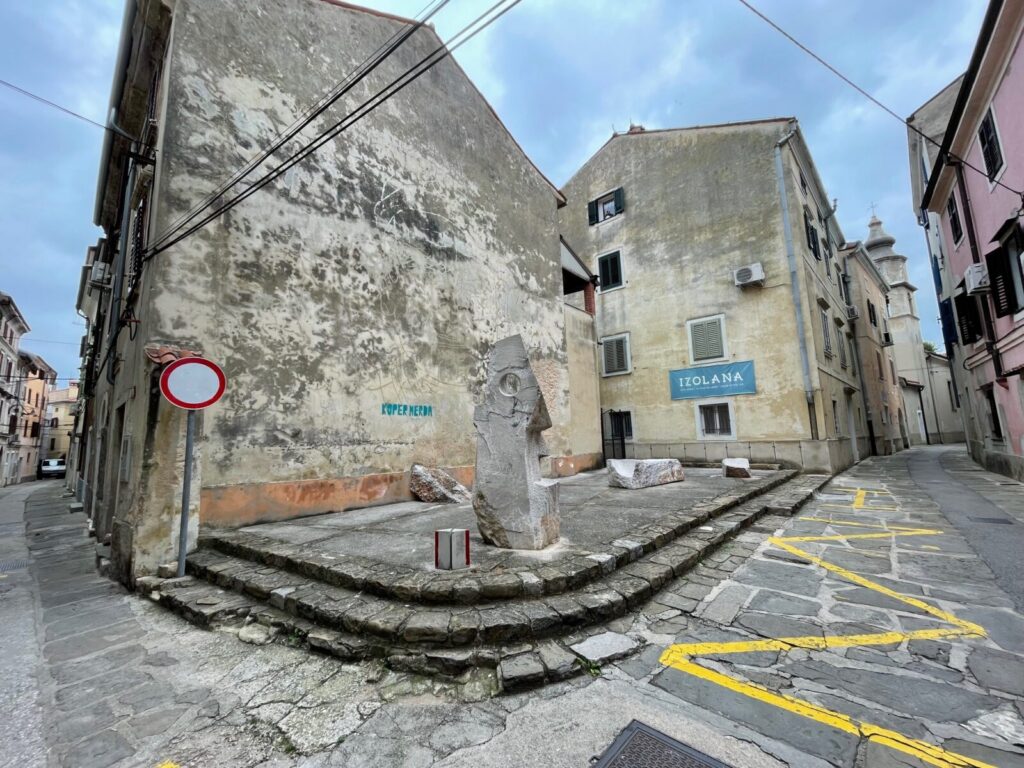
The site at the intersection of Alma Vivoda Street and Smrekar Street in Izola covers approximately 70 m² and is located next to the Izolana Museum. It is currently a concrete surface featuring stone sculptures, occasionally used for motorcycle parking. In the past, waste containers were placed there. Although this space has existed for decades, it has not fulfilled any ecological functions. It is situated alongside a moderately busy road used by both motor vehicles and a considerable number of pedestrians. The site has the potential to become a more pleasant public space, suitable for activities such as children’s play or relaxation.
The proposed pilot project includes the installation of permeable sandy pedestrian surfaces, the creation of a green wall with climbing plants on a blank façade, the planting of a tree and the installation of a wooden bench and a waste bin, while preserving the existing stone sculptures and diagonal patterns in the paving. Permeable paving will allow some rainwater to infiltrate the ground during heavy rainfall instead of flowing across paved surfaces, potentially reducing the risk of local flooding while retaining soil moisture for plants. The new tree and climbing plants on the façade will help reduce heat through shading and evapotranspiration, a process in which water from the soil and plants is released into the atmosphere, absorbing heat from the surrounding environment. The new vegetation could also turn the area into a habitat and stepping stone for pollinators, strengthening the city’s ecological connectivity.
Although such an intervention cannot replace larger parks, it makes a positive contribution in places where larger-scale projects are not feasible. It also helps create networks of interconnected green corridors and small green islands that together function as an integrated urban system, forming the city’s green infrastructure.
A Greening Strategy and Consistent Implementation as the Foundation
For the Municipality of Izola, the pilot project represents a small part of a longer-term strategy for urban greening and the introduction of nature-based solutions. In 2014, the municipality renovated the Sončno Nabrežje waterfront, upgraded the sewerage and drainage systems and improved flood protection in this part of the town. In the same year, a recreational park with green spaces was established in Livade.
This was followed by the planting of several thousand trees through projects such as “Izola, Green City” and “One Hybrid, One Tree”, as well as the adoption of an overarching green policy in 2020, aimed at connecting green spaces, climate measures and residents’ well-being.
Six dry retention basins were constructed along three torrential watercourses to reduce flood risks. The 2023 strategic document “Greening of Izola” outlines an integrated approach to identifying priority areas for greening and measures to address water-related challenges.
The “Zelenatura” project enabled detailed mapping and the selection of new locations for urban greening. It also supported the transformation of green spaces within the residential block between Cegnar Street and the Square of the Fallen for Freedom into public park areas with community gardens. These initiatives promote local food production and residents’ self-sufficiency while improving and monitoring microclimatic conditions and assessing the impact of green spaces on thermal comfort in urban environments.
Designing Public Spaces Together with Local Residents
An important aspect of this project is its participatory approach to designing the intervention. The Municipality of Izola combines the implementation of its greening strategy with public participation in individual projects. We are following the same approach in this case.
The location was selected based on previous mapping of potential green spaces and an assessment of feasibility within the project’s financial, time and material constraints, while involving various stakeholders.
The conceptual design was developed by the municipal Spatial Planning Office in collaboration with a landscape architecture studio, with the involvement of the artist who created the existing sculptures.
Japanese sculptor Masayuki Nagase, who currently lives in the United States, resided in Istria between 1979 and 1996 and installed the sculptures in 1984 and 1985. Although several decades have passed since then, the Municipality of Izola successfully re-established contact with the artist and developed a constructive working relationship during the renovation planning process.
The artist, whose current projects also involve urban green infrastructure, supports the proposed redesign. His only suggestion was to remove the originally planned bench, as it would interfere with the authenticity of the original artistic composition.
During the design phase, consultations were also held with the Institute for the Protection of Cultural Heritage of Slovenia to ensure that the historical identity of the site would be preserved while successfully introducing a nature-based solution.
The conceptual design was then presented to local residents and adapted based on their knowledge and preferences. For example, the selection of climbing plants and tree species was adjusted to favour non-allergenic varieties.
Open, facilitated discussions provided not only an opportunity to discuss the specific intervention but also valuable insights into residents’ needs, which the municipality can take into account in other planning processes, such as traffic management and improving accessibility for people with reduced mobility. In this way, the ideas developed through this project can inform future public space initiatives.
By actively involving residents in spatial planning processes, we not only improve the physical environment but also strengthen the skills needed for participation and collaboration, which are essential for the long-term success of such interventions.
A Pocket Park as Inspiration for Others
The pilot project is currently in the final stages of preparing the technical documentation required for implementation. The new public space is expected to come to life in 2027.
The Izola pilot will demonstrate the value and feasibility of carefully designed sustainable solutions that combine long-term strategic commitment, community participation and the preservation of historical heritage with climate change adaptation.
Through this project, we aim to highlight that effective measures to mitigate heat and retain water in densely built historic urban centres do not necessarily require large-scale interventions. They can also be based on small, interconnected improvements to existing public spaces that respect established artistic and heritage values.
AUTHORS: Jerneja Penca, PhD, and Jena Jamšek, PhD, Mediterranean Institute for Environmental Studies at ZRS Koper, and Melita Osvaldič and Teura Raschini, Municipality of Izola
PHOTO: Jena Jamšek


This article was prepared as part of the LIFE4ADAPT project (Slovenia’s Strategic Integrated LIFE Project for Adaptation – LIFE-2023-STRAT-CLIMA-SIP, project No. 101147797) and the research programme Mediterranean Agricultural Practices and Societies Adapting to Environmental Change (P5-0453), led at ZRS Koper by Dr Jerneja Penca. The LIFE4ADAPT project has received funding from the European Union under the Programme for the Environment, Climate Action and Nature. The views and opinions expressed in this article are those of the authors only and do not necessarily reflect those of the European Union or the European Climate, Infrastructure and Environment Executive Agency (CINEA). Neither the European Union nor the granting authority can be held responsible for the content. The research programme Mediterranean Agricultural Practices and Societies Adapting to Environmental Change is funded by the Slovenian Research and Innovation Agency (ARIS).