 en
en Slovenščina
 Italiano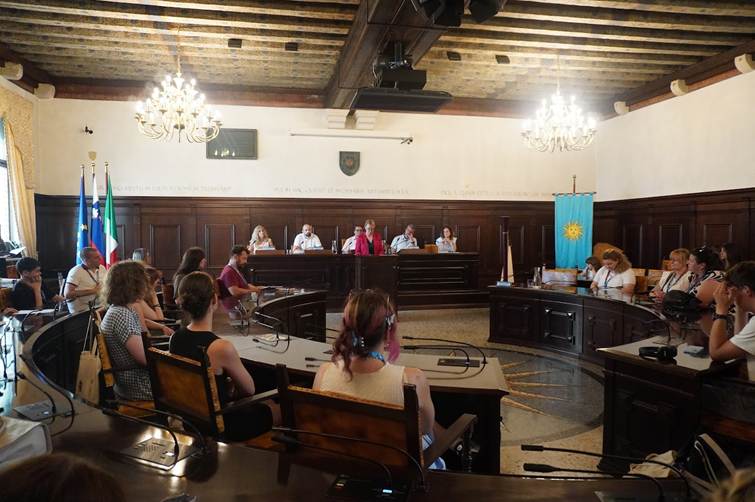
The 33rd “Hello, This Is the Slovenian Mediterranean!” Slovenian Language Summer School officially opened at the Pretorian Palace in Koper on 13 July 2026. Until 22 July, Koper will host 50 participants from 16 countries, brought together by their interest in the Slovenian language, their desire to integrate more fully into Slovenian society, and their wish to learn about Slovenia’s culture and way of life.
In his opening address, Prof. Dr Aleksander Panjek, Dean of the University of Primorska Faculty of Humanities, highlighted language as one of the principal carriers of culture and the memory of past generations. He placed particular emphasis on Istria’s multilingual and multicultural experience and on the importance of knowing and understanding different languages to improve communication and mutual understanding.
Aleš Oven, Assistant to the Rector, spoke about the international orientation of the University of Primorska. Almost 1,500 international students currently study at the University, which is also home to approximately one hundred researchers from abroad. For some of them, the summer school was their first encounter with the University of Primorska and the local environment in which they later continued their studies or research careers.
Dr Tilen Glavina, Deputy Director of the Science and Research Centre Koper (ZRS Koper), emphasised that ZRS Koper has been involved in organising the summer courses since their inception and is pleased to support the learning of the Slovenian language and the exploration of Slovenian culture. According to him, this form of connection is also closely associated with the spirit of the Mediterranean region, which has always been characterised by encounters between languages, cultures and people.
Dr Vesna Mikolič, who initiated the courses and heads the Institute for Linguistic Studies at ZRS Koper, reflected on changes in methods of communication since the summer school was first held. Given the growing role of modern technologies, she highlighted the importance of direct human communication, as it is precisely this form of interaction that builds relationships, a sense of belonging and identity. She stressed that language skills are becoming more important than ever—not because machines are unable to use languages, but because only human beings can imbue language with meaning, emotion, humour, respect, empathy and mutual trust.
Dr Helena Jaklitsch, State Secretary at the Government Office for Slovenians Abroad, emphasised that learning Slovenian involves more than simply acquiring language skills: it also opens the door to Slovenian literature, culture, everyday life and ways of thinking. According to her, the summer school is particularly valuable because the language also comes to life outside the classroom through socialising, conversations and shared experiences. She also expressed her support for projects that develop new approaches to teaching and promoting the Slovenian language.
At the opening ceremony, Dr Klara Šumenjak, Head of the Centre for Slovenian Language and Culture at the University of Primorska Faculty of Humanities, particularly acknowledged the work of the many colleagues who prepare the summer school throughout the year. As she noted, artificial intelligence can facilitate and accelerate numerous processes, but it cannot replace people, their knowledge, creativity and personal interaction.
She also presented the learning materials that participants will use during this year’s Slovenian language course. In addition to the textbooks developed specifically for the summer school by the Centre for Slovenian Language and Culture at the University of Primorska Faculty of Humanities, this year’s new materials include two grammar handbooks featuring clear and accessible tables. The new handbooks will provide participants with additional support in understanding, consolidating and applying Slovenian grammar rules in practice.
The participants come from Italy, Austria, Hungary, Bosnia and Herzegovina, Serbia, Montenegro, Czechia, Germany, Romania, North Macedonia, Belarus, Russia, the United States, Brazil, Argentina and Australia. Although they came to Koper for different reasons, they all share a desire to improve their knowledge of the Slovenian language and gain a deeper understanding of the local environment.
Twenty-year-old Lana Stojkovski from Serbia enrolled in the course on the recommendation of her Slovenian language teacher. Her main motivation for learning Slovenian is her wish to continue her studies in Slovenia in the future.
Christian and Aurelia Heilwagen, a married couple from Germany, enjoy travelling and discovering new places, and it was their desire to explore the world that brought them to Koper. They see learning Slovenian as an opportunity to gain a deeper understanding of Slovenian culture and the local environment. As they are considering moving permanently to Slovenia, they view the Slovenian Language Summer School as a stepping stone towards life in a new community.
Isobel Keen and George Savvoudis, a young couple from Australia, have been living in Koper for a year and a half. Alongside their studies and work, they would like to improve their knowledge of Slovenian, which they regard as an important prerequisite for integrating into the local community and establishing more meaningful relationships with people.
Over the coming days, participants will study Slovenian during morning language classes and expand their language skills and knowledge of Slovenia through creative and social workshops and an excursion to the Karst region. Until 22 July, Koper will once again serve as a meeting place for diverse cultural and linguistic worlds, united by a shared desire to learn, communicate and better understand Slovenia’s Mediterranean region.
The Slovenian Language Summer School is organised by the University of Primorska Faculty of Humanities in cooperation with the Science and Research Centre Koper (ZRS Koper), with financial support from the Government Office for Slovenians Abroad and the support of the City Municipality of Koper.
