 en
 Slovenščina
 Italiano
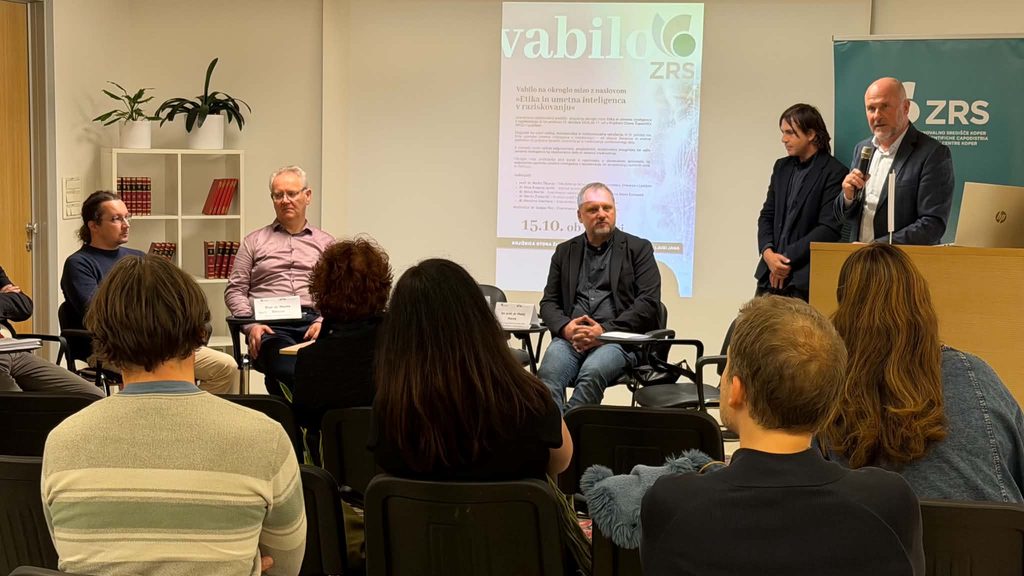
Artificial intelligence (AI) is increasingly transforming the research environment and raising questions concerning ethics, research integrity, authorship and research funding. These challenges were discussed at a round-table event held on 15 October at 11:00 a.m. at the Oton Župančič Library in Ljubljana. The event was organised by the Science and Research Centre Koper (ZRS Koper) in cooperation with the Slovenian Research and Innovation Agency (ARIS).
In his opening address, the Director of ZRS Koper, Professor Rado Pišot, emphasised that the responsible use of AI is simultaneously a technical, ethical and institutional issue. ZRS Koper also addresses this subject through the Adriatic Laboratory for Digital Humanities and Innovative Cultural Heritage Research (ALDHI) and by connecting different research groups.
Dr Klemen Miklavič, Deputy Director of ARIS, pointed out that AI will also affect research funding. Existing models for evaluating research achievements and allocating funds will therefore need to be adapted. In developing new approaches and methodologies, ARIS cooperates with the international community of research funding organisations.
Responsibility, Transparency and Authorship
Dr Massimo Sbarbaro, Head of the Adriatic Laboratory for Digital Humanities and Innovative Cultural Heritage Research (ALDHI) at ZRS Koper, stressed that the use of generative artificial intelligence in research should move beyond distrust and focus instead on methodological transparency and the verification of results. Rather than merely declaring that AI was used, he advocated documenting the system employed, its version, the purpose for which it was used and the method used to verify its outputs.
Using the work conducted at the ALDHI laboratory as an example, he demonstrated how AI can assist in searching for information within extensive corpora of historical sources, while reading, verification and interpretation remain the responsibility of the researcher. He emphasised that scientific responsibility must always remain human and personal.
Professor Marko Robnik Šikonja of the Faculty of Computer and Information Science at the University of Ljubljana emphasised that the use of AI requires us to formulate more demanding and higher-quality questions. Researchers must take responsibility for their work and clearly state how and for which tasks they used AI. He also drew attention to the overproduction of scientific content, which calls for a reconsideration of how articles are prepared and published, as well as of existing research methodologies.
Dr Maja Bogataj Jančič of the Intellectual Property Institute highlighted the importance of clear institutional guidelines and the distinction between the public research environment and commercial technology companies. In scientific authorship, the central creative contribution must remain human, while the use of AI must be disclosed transparently. She also emphasised the need for greater accountability among technology companies, appropriate regulation and closer cooperation between academic institutions. Slovenia has a sound legal foundation in the field of open science, but its practical implementation remains a challenge.
Dr Martin Žnidaršič of the Jožef Stefan Institute raised the question of co-authorship and the boundaries between human and AI contributions. He pointed to the advantage enjoyed by researchers who already use these tools effectively, as well as the new challenges posed by autonomous agents. Their processes can be complex and difficult to monitor, making transparency in their operation increasingly important.
Dr Matej Mertik of ZRS Koper and Alma Mater Europaea drew attention to the rapid pace of technological change and the need for researchers to receive continuous training in the ethical use of AI. He particularly highlighted the social sciences and humanities, where researchers face specific challenges. Clear methodological guidance and documentation of AI use are essential for consistent research practice.
Towards Common Guidelines
The discussion demonstrated that the responsible use of AI requires the verification of results, clear rules concerning authorship and accountability, and the adaptation of research methodologies.
In his concluding remarks, Dr Sbarbaro encouraged further cooperation in preparing practical ethical guidelines that could be reviewed and updated quickly. The meeting and discussion will soon continue at ZRS Koper in Koper, where participants will be able to build on the exchange of views and continue their joint search for guidance on the responsible use of artificial intelligence in research.
The event was organised with the support of the Slovenian Research and Innovation Agency (ARIS).