 en
en Slovenščina
 Italiano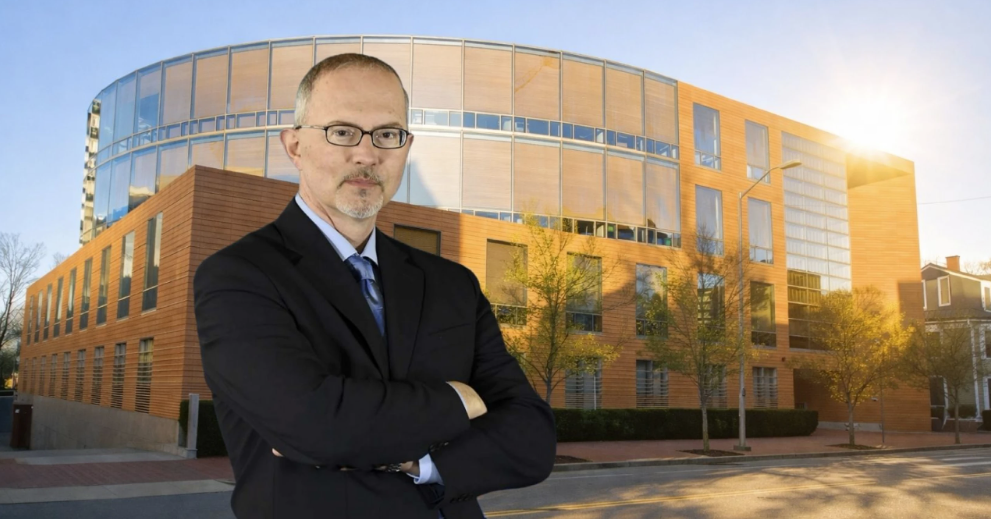
How can democracy be understood in times of environmental crises, wars, and growing social indifference? And what if its foundation is something as basic as breathing?
These questions will be addressed in an international academic context by Dr Lenart Škof, Head of the Institute for Philosophical and Religious Studies at the Science and Research Centre (ZRS) Koper, who will appear as a visiting lecturer at Harvard University. Within the seminar Interdisciplinary Perspectives at the Weatherhead Center for International Affairs, he will present a lecture titled “Democracy as Shared Breath: Vulnerability, Ethics, and Religion in the Public Space.”
More information about the seminar and registration is available HERE.
The conference will be held via Zoom on April 1 at 7 p.m. Central European Time.
The event is free of charge and open to all interested participants.
Democracy as “shared breathing”: a new philosophy of coexistence
In his lecture, Dr Škof develops an original concept of democracy as “co-breathing,” grounded in his so-called respiratory philosophy. He places at the center the idea that breathing – as a fundamental human experience – is also an ethical and political space in which human relations are formed.
In doing so, he draws on Richard Rorty’s neo-pragmatism and understands philosophy as a form of cultural politics. He interprets democracy as a community of vulnerable beings, where the experience of vulnerability enables genuine ethical coexistence – while also requiring protection from the forces of capital, systemic violence, and political indifference.
From the “politicocene” to the right to breathe: an ethics of the future
A special focus of the lecture is the development of the field of critical respiratory studies, which treats breathing and atmosphere as key political spaces. Within this framework, Škof analyzes the contemporary era, which he terms the “politicocene” – a time marked by various forms of “atmospheric violence,” from police chokeholds to polluted air, industrial suffocation, and war-related pandemics.
As a counterpoint to these trends, he advocates the idea of a universal right to breathe, also developed by philosopher Achille Mbembe, and opens the question of the future of religion in a post-Christian world. In this context, he understands religion as a space of shared ethical sensitivity, inspired by John Dewey’s idea of “common faith.”
An internationally recognized philosopher
Dr Lenart Škof is Head of the Institute for Philosophical and Religious Studies at ZRS Koper, Dean of ISH Faculty at Alma Mater Europaea University, and Professor of Philosophy and Religious Studies. His research bridges American pragmatism, continental philosophy, and Asian philosophical traditions. He is the author of several widely recognized scholarly works, including God in Post-Christianity (2024), Antigone’s Sisters (2021), and Breath of Proximity (2015), and co-editor of a recent monograph on war, trauma, and justice (Routledge, 2025).
His work is also marked by extensive international experience – including as a Fulbright researcher at Stanford University, where he collaborated with Richard Rorty, and as a Humboldt research fellow in Germany.
The lecture at Harvard thus represents not only an important recognition of Slovenian philosophy, but also an invitation to reflect: what does it mean to live – and breathe – together in the world of the future?