 en
en Slovenščina
 Italiano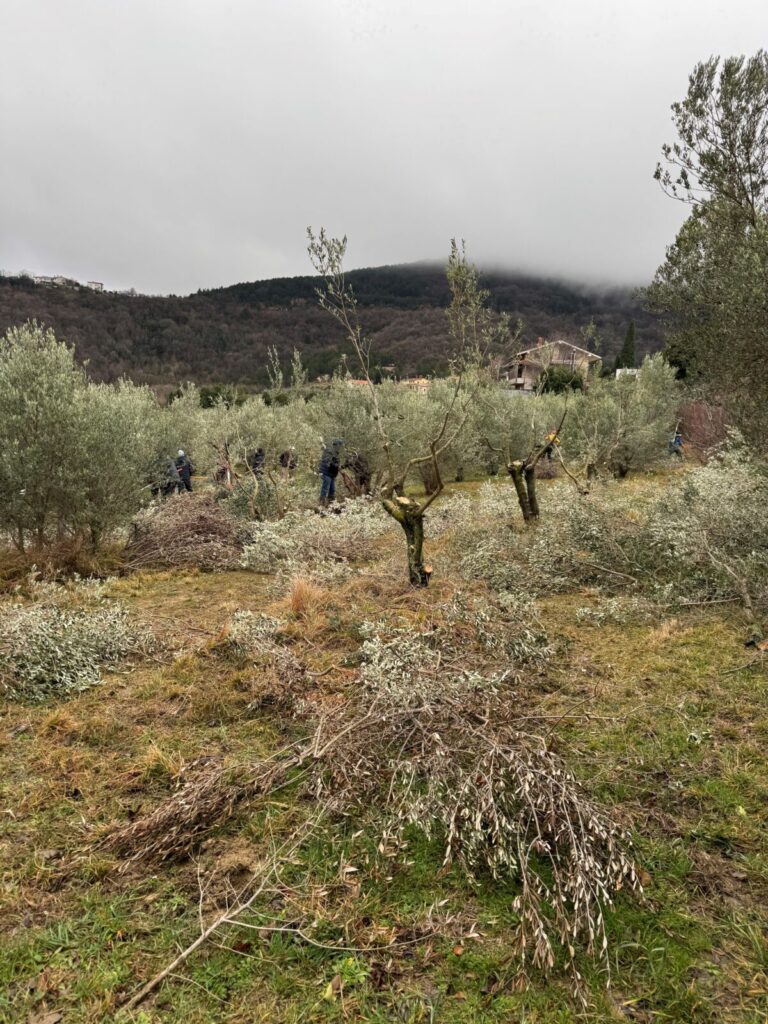
Between february 4 and 7, the Institute for Olivecultureof Science and Research Centre Koper (SRC Koper) hosted, for the second consecutive year, a prestigious international training course on olive tree renewal pruning. The training was organized within the framework of the Scuola Potatura Olivo school, in collaboration with Antonina Filippa Lonobila, a renowned Italian expert in sustainable olive growing.
An advanced course on olive tree renewal pruning (February 4–5, 2026) and a basic olive pruning course (February 6–7, 2026) were also held. A total of around 100 participants from Slovenia, Italy, and Croatia attended the training courses, confirming the great interest in professional olive tree pruning based on research and practice and the importance of international cooperation and knowledge exchange.
An important part of the professional discussion during the event was devoted to carbon dioxide capture, with research showing that traditional olive groves have a greater capacity for carbon sequestration and a smaller carbon footprint than super-intensive plantations. Due to the longer lifespan of trees, greater woody biomass, and less intensive soil cultivation — resulting in slower decomposition of organic matter — traditional olive groves act as significant carbon sinks and contribute substantially to climate change mitigation. At the same time, they shape the landscape, preserve biodiversity, and represent a more stable long-term land-use model. From an economic perspective, super-intensive plantations may be more profitable in the short term, but in the long term they put greater pressure on the environment, soil, and water resources. Therefore, they do not represent a sustainable solution in sensitive Mediterranean environments such as Slovenian Istria.
Experts also devoted considerable attention to olive tree protection, highlighting several widespread but incorrect practices. In the case of diseases such as peacock spot, timely and preventive protection of leaf mass is essential, as the pathogen overwinters on older leaves and can rapidly spread to young leaves under favorable conditions. Preventive measures implemented on time and in accordance with the olive tree’s developmental stages — before new leaf mass develops — are significantly more effective than later curative interventions. This also applies in cases where heavily infected old leaves fall off following preventive treatment.
Early monitoring of the olive fly population and timely action at the first appearance of adults – as early as March – are key to limiting the initial population growth and reducing its reproductive potential at a time when the fruits are most vulnerable to attack. The early appearance of the olive fly can be limited by using pheromone traps, but caution is advised as these are mainly effective in larger, compact areas; otherwise, flies from neighboring olive groves may be attracted.
The discussion also touched on pruning olive trees in winter and early spring. Pruning olive trees during dormancy (December and January) does not pose a risk of frost damage. On the contrary, premature pruning (in autumn), carried out before dormancy, can stimulate vegetative growth and increase the sensitivity of trees to low temperatures.
The event once again confirmed that the future of olive growing in Slovenia is grounded in knowledge, scientifically supported practices, and the preservation of traditional olive groves, which carry not only productive but also important environmental, landscape, and cultural value. The Olive Growing Institute of ZRS Koper will continue to promote knowledge transfer and professional dialogue aimed at the sustainable development of olive cultivation.