 en
en Slovenščina
 Italiano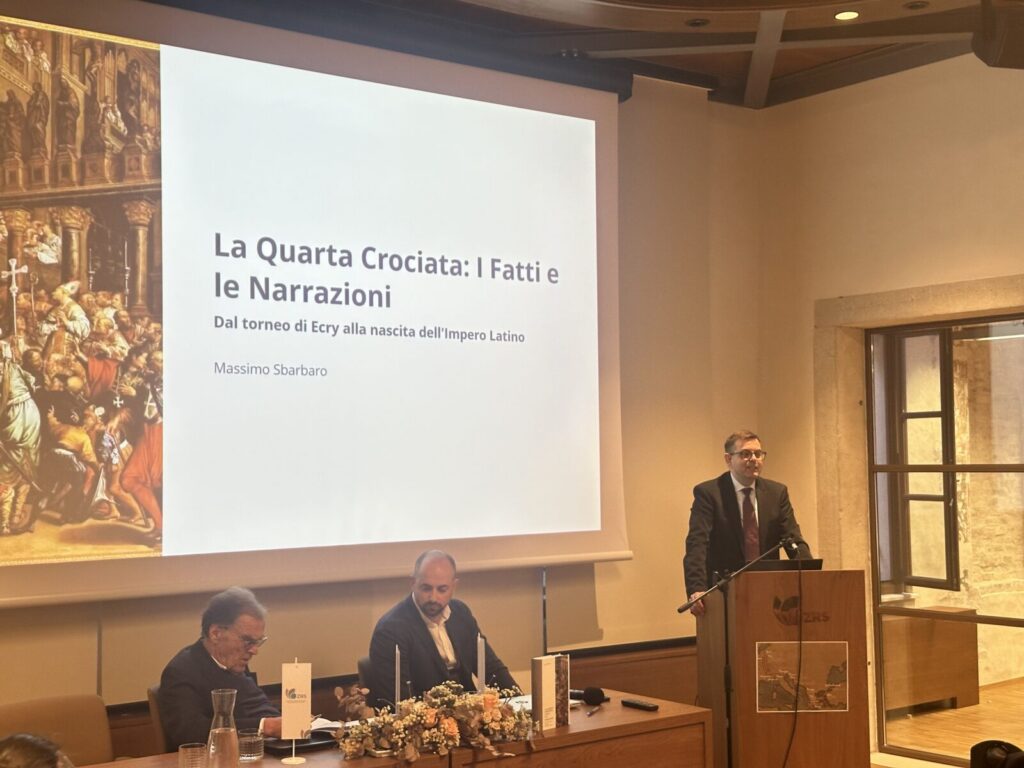
At the Centre for Humanities of ZRS Koper, on Tuesday, March 24, 2026, a presentation was held for the book La Quarta Crociata: i fatti e le narrazioni: Dal torneo di Écry alla nascita dell’Impero Latino (“The Fourth Crusade – from the knightly tournament at Écry to the establishment of the Latin Empire”) by Dr Massimo Sbarbaro, a researcher at the Institute for Historical Studies of ZRS Koper.
The work examines the Fourth Crusade from its beginnings in France, at the tournament of Écry in 1199, to the establishment of the Latin Empire in 1204. The original plan of a “passage to the Holy Land” gradually evolved into an expedition that ended with the capture of Constantinople. The narrative focuses on key turning points: the choice of Venice as the point of departure for transporting the crusaders, the conclusion of the shipping contract and its concrete consequences, the diversion toward Zadar, the agreement with Alexios Angelos, the arrival in Constantinople, the two sieges of 1203 and 1204, the sack of the city, and the establishment of a new political and territorial order in the East.
The methodological approach of the book is clear: each phase of the war is reconstructed through a systematic comparison of narrative sources, ensuring that the interpretation of events does not rely on a single testimony. Among the key narrative sources are the French chroniclers Geoffroi de Villehardouin and Robert de Clari, complemented by the Latin texts Devastatio Constantinopolitana and Historia Constantinopolitana by Gunther of Pairis. Venetian narrative sources are also taken into account, especially the chronicle of Martin da Canal and the later historiographical tradition of the 16th century associated with Giovanni Battista Ramusio, as well as the work of the Byzantine historian Niketas Choniates. This results in a multi-layered reconstruction in which the same events appear through different perspectives, moral frameworks, and interpretations.
The book also sheds light on the relationship between political decisions and their practical constraints. The organization of the expedition, the debt to Venice, and the crisis of the Byzantine world form an intertwined framework of action. The march toward Constantinople thus emerges as the result of the convergence of original plans, unforeseen circumstances, political calculations, and concrete opportunities. In this sense, the Fourth Crusade appears as the intersection of three distinct historical and political logics: the Byzantine imperial tradition, the feudal order of the Latin West, and Venetian commercial rationality.
The work offers a scientifically grounded yet narratively accessible interpretation of one of the most controversial events of the Middle Ages, which had a lasting impact on relations between East and West and on the rise of Venice in the Mediterranean.
About the Author
Massimo Sbarbaro (Parma, 1969) is a researcher in medieval history at the Institute for Historical Studies of the Science Research Centre (SRC) Koper. He earned his PhD in history at the University of Trieste, where he also taught for more than ten years. His works include Le delibere dei Consigli dei Comuni cittadini italiani (secoli XIII–XIV) (2005), Storia e informatica: i data base applicati ai documenti medievali (2007), and Il dazio a Gemona. Per la storia delle imposte indirette nel medioevo (2010). At the University of Ljubljana (Faculty of Arts), he is completing a second doctorate in the field of digital humanities.
This book is the result of a decade of research on the Fourth Crusade and opens a trilogy dedicated to reconstructing the event, its political and territorial consequences, the economic and contractual dimensions of the expedition, and the formation of its memory.