en
en Slovenščina
 Italiano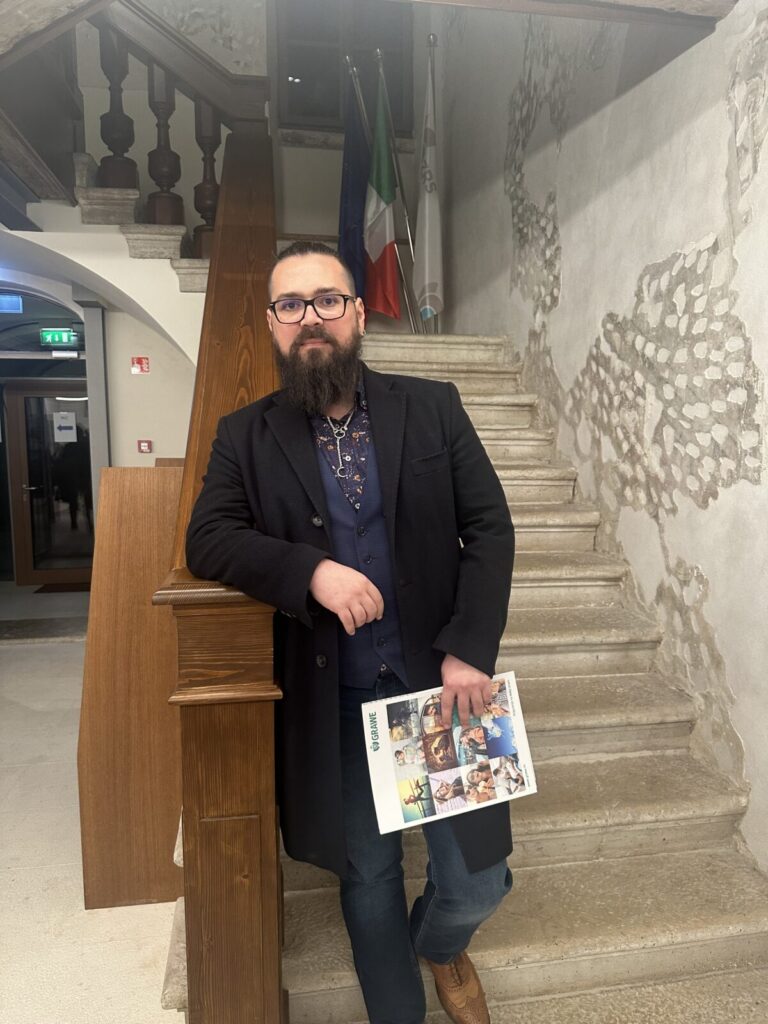
Organized by the Institute of Historical Studies at ZRS Koper, the VENIKO project – “(Dis)Empowering Interactions: Venetian Statehood and Koper in Late Medieval Istria (14th–16th Century)” – officially began on Tuesday, March 24, 2026. The event took place at the Centre for Humanities of ZRS Koper.
The project examines the functioning of the Venetian state and the relationship between the central authorities in Venice and Koper, one of the key cities of Venetian Istria in the late Middle Ages. Based on new archival research and the analysis of previously underexplored sources, the project sheds light on mechanisms of power, the judiciary, and social relations within the Venetian state, as well as the role of local elites in these processes.
The project leader, Dr Josip Banić, presented the main research objectives, methodological approach, members of the research team, and the expected outcomes. The team consists of seven researchers, including experienced scholars, early-career researchers, and two doctoral candidates from ZRS Koper.
An Archive Closed for Over 70 Years
At the heart of the project is the old municipal archive of Koper—an exceptionally important collection that was transferred to Italy during the Second World War. The archive remained closed to the public until 2016, when it was finally opened at the State Archives in Venice. The reasons for its prolonged closure were closely tied to competing nationalist claims over the city’s cultural heritage.
“Opening this archive is a once-in-a-generation opportunity,” says Dr. Banić. “For the first time, we have access to a vast body of primary sources that allow us to explore the everyday life of late medieval Koper—how the state functioned, how justice was administered, and how local elites interacted with Venetian authority.”
Koper as the Capital of Venetian Istria
The project focuses on the period from the 14th to the 16th century, when Koper evolved from a subordinate community into the regional capital of Venetian Istria. During the same period, Venice itself was transforming from a city commune into one of the most powerful territorial states in Italy. Researchers will examine how these parallel transformations influenced one another and shaped the lives of the population.
The research team will address three key questions: how Venice balanced centralized control with local self-governance, how the judicial system functioned in practice, and how local patrician families leveraged their position between the state and the urban community.
Critical Edition of the “Black Book”
A key outcome of the project will be a critical edition of the Liber Niger (“Black Book”), a large parchment codex consisting of 273 folios, in which Koper’s magistrates recorded the decrees of Venetian doges between 1382 and 1494. This exceptional source, never before published, will become accessible to the wider scholarly community for the first time. The publication will include introductory studies, a critical apparatus, and indices.
“Liber Niger is not merely a collection of official letters. It is a window into the functioning of a Renaissance state. It reveals how the state intervened in urban administration, how it communicated with its subjects, and what language of power it employed,” explains Dr Banić.
Beyond Nationalist Polarizations
In addition to its scholarly importance, the project also carries a significant social dimension. Venetian rule over Koper (1279–1797) has historically been interpreted in sharply contrasting ways—either as a beacon of Italian identity or as foreign oppression. The project aims to move beyond these polarized interpretations through methodologically rigorous, source-based research.
“We aim to contribute to a more nuanced understanding of the shared heritage of this region,” adds Dr Banić. “The history of Koper is neither exclusively Slovenian nor exclusively Italian. It is shared and complex—and deserves to be treated as such.”
As part of the project, three public workshops, two public lectures, and an international scientific conference will be organized in Koper. The publication of the Liber Niger will be formally presented in both Koper and Venice during the final month of the project.
The VENIKO project – “(Dis)Empowering Interactions: Venetian Statehood and Koper in Late Medieval Istria (14th–16th Century)”, led by Dr Josip Banić (project ID J6-70217), is funded by the Slovenian Research and Innovation Agency (ARIS) from the state budget.