 en
 Slovenščina
 Italiano
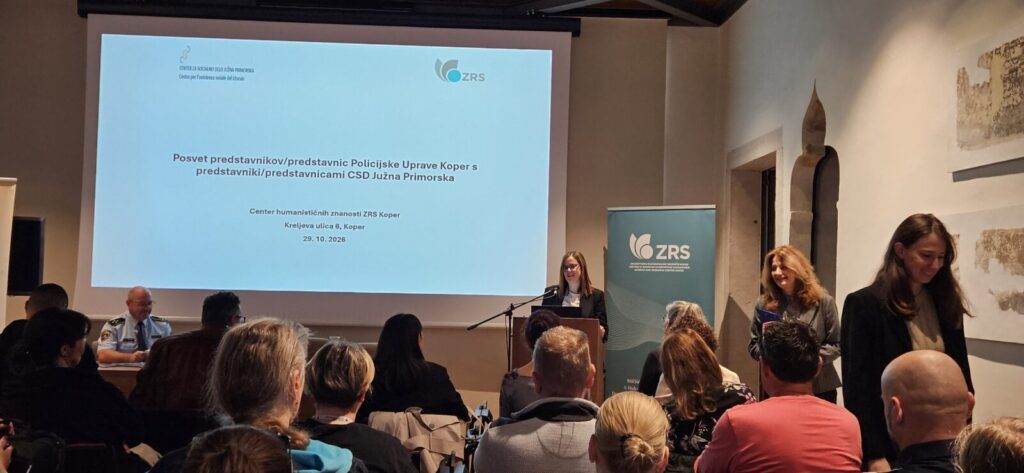
On Thursday, 29 October 2026, the Science and Research Centre Koper, in cooperation with the South Primorska Social Work Centre, organised a consultation meeting between representatives of the Koper Police Directorate and the South Primorska Social Work Centre. The meeting focused on how improved cooperation and the exchange of experience can contribute to a more effective response to violence and better protection of vulnerable people.
The meeting was attended by representatives of the Koper Police Directorate, including the Uniformed Police Division, the Criminal Police Division and the police stations in Koper, Izola, Piran, Sežana and Kozina, as well as professionals from the South Primorska Social Work Centre who work with victims and perpetrators of violence.
The event attracted a large number of participants from the Koper Police Directorate, the participating police stations and the South Primorska Social Work Centre.
Following the opening addresses, the first section focused on the prevention, handling and prosecution of domestic violence, as well as police responsibilities in cases of violence against children and peer violence. Damjan Sever, Head of the General Police Duties Department within the Uniformed Police Division, presented the handling of domestic violence offences, the issuing of restraining orders under the Police Tasks and Powers Act and the provision of police assistance. Nina Križ, Specialist Criminal Police Inspector in the Criminal Police Division, then discussed cooperation between the Police and social work centres and the rights of minors in police procedures. Matej Družina, Specialist Criminal Police Inspector in the Criminal Police Division, spoke about the prevention of peer violence.
Following the break, the responsibilities of social work centres in preventing domestic and peer violence were presented. Ksenija Balantič, a professional from the Sežana unit, outlined the centre’s responsibilities concerning violence prevention and the protection of children’s best interests. Damjana Jurman, MA, Violence Prevention Coordinator, described the work of the emergency intervention service. Irena Marjeta Evačič, Head of the Marelična hiša Crisis Centre for Children and Adolescents, and Renata Fabec, Head of the South Primorska Crisis Centre for Victims of Violence, presented the work of the crisis centres, while Valentina Kovač, Head of the Kras Regional Safe House, presented the operation of the safe house.
A central part of the meeting was the interactive session, during which participants exchanged experiences of their cooperation. They commended the effective and professional collaboration between the Police and social work centres. Several challenges were also identified, with participants agreeing that these must be addressed continuously and resolved through joint efforts.
The meeting concluded with presentations of two relevant projects being implemented in Koper. Mirna Buić from the PiNA Association for Culture and Education and Anastasiia Gusakova from the Association of Pensioners’ Societies of the City Municipality of Koper – Morje Intergenerational Centre presented the project Strengthening Intercultural Dialogue: Intercultural Mediation in Public Institutions within the Koper and Izola Administrative Units. Sandra Končan, a researcher at the Institute for Social Studies of ZRS Koper, explained the importance of the international SIS-Hubs project, which promotes cooperation, integration and violence prevention within the local community.
Events such as this remind us that the effective protection of victims and the key changes needed to reduce the risk of repeated violence begin at the local level. Only through cooperation among public authorities and organisations and engagement with the community can we create environments in which victims of violence are identified in time, heard and appropriately protected.
Photo: Sandra Končan, SIS-Hubs Project Coordinator, speaking about the importance of connecting the local community and adopting a preventive approach to gender-based violence.