 en
 Slovenščina
 Italiano
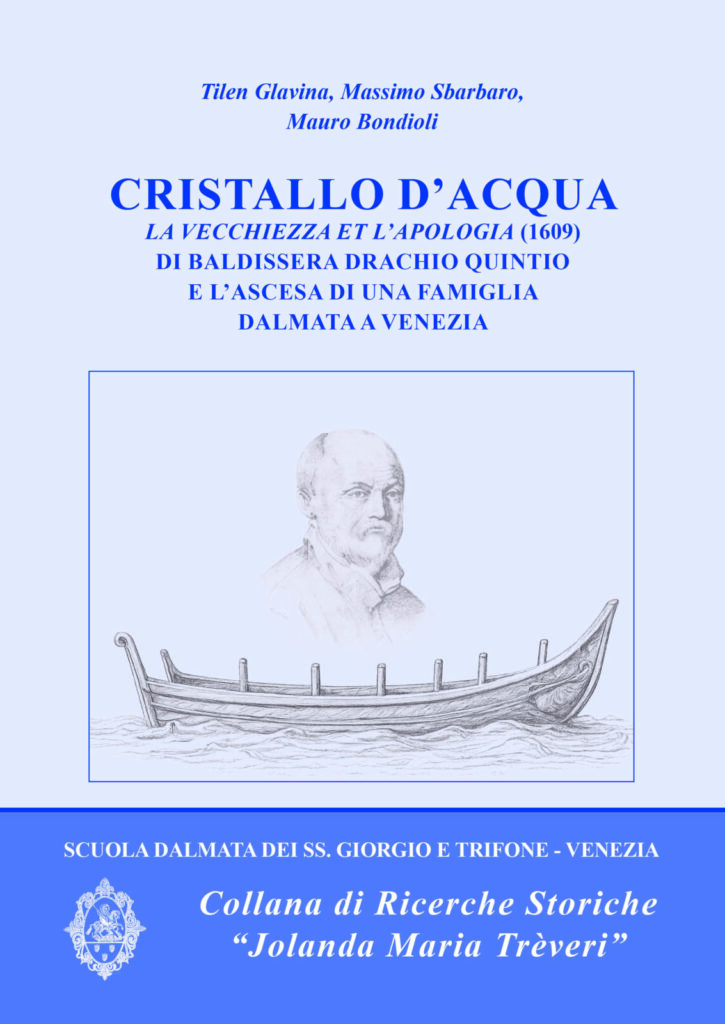
In January 1609, a 76-year-old expert at the Venetian Arsenal wrote a lengthy letter to the Doge. He was not asking for money, as the Senate had already granted him a lifetime pension several years earlier, but for recognition of his social standing and achievements, which could be passed down to his children. He received no reply. The manuscript then remained in a library for four centuries and has now been published in full for the first time.
In October this year, the Scuola Dalmata dei Santi Giorgio e Trifone (Dalmatian School of Saints George and Tryphon) in Venice celebrated its 575th anniversary. Following a solemn Mass celebrated by the Patriarch of Venice, Francesco Moraglia, at the Church of San Giovanni di Malta, the monograph Cristallo d’acqua (Water Crystal) was presented. The book was written by Dr Tilen Glavina and Dr Massimo Sbarbaro of the Institute for Historical Studies at the Science and Research Centre Koper (ZRS Koper), together with Mauro Bondioli of Ars Nautica, the Croatian institute for maritime heritage.
Son of a Dalmatian carpenter
Baldissera Drachio was born around 1533 into a family that had migrated from Dalmatia to Venice and settled in the Castello district, not far from the Arsenal. His father was a shipwright at what was then Europe’s largest state-owned shipyard. His understanding of his own origins is revealed in his will of 1563, preserved in the State Archives of Venice, which the authors were the first to examine and transcribe. In the document, he identifies himself as “Zuan de Drago de Dalmatia”, or Ivan Drago from Dalmatia, suggesting that the surname, which first became Drago and later Drachio in Venice, may have originated from the name Dragan.
The son went further than his father. He entered the Arsenal in 1546 and by 1571 had become head of the shipwrights’ guild. In 1586, he proposed a reform that would replace the secret templates used by individual master craftsmen with standardised galley designs, introduce a shared inventory of materials and establish stricter supervision of work. It was a form of industrial rationalisation ahead of its time. The workers responded with violence. Drachio was barred from entering the Arsenal for seven years, subjected to insults in the streets, and even threatened by armed men waiting in a boat near his house in Chioggia. It was not until 1594 that the Senate reinstated him, following a recommendation from the patrician Giacomo Foscarini. Eleven years later, in recognition of his advanced age, the Senate granted him a lifetime pension, releasing him from the obligation to continue working at the Arsenal.
The water that became crystal
The manuscript Drachio sent to Doge Leonardo Donà consists of two parts. In La Vecchiezza (Old Age), he draws inspiration from Cicero’s dialogue but reverses its perspective. He first acknowledges that old age deprives the body of beauty and strength, yet uses this very observation to argue that a wise elderly man is an indispensable adviser to the state. In L’Apologia (The Defence), he lists his achievements and the injustices associated with his old age, concluding with the metaphor that gave the book its title. Nature, he explains, can transform water into crystal, but it cannot turn crystal back into water. Sixty-two years of service had likewise transformed Drachio into a solid crystal. In this way, he conveyed to the Doge that an old man such as himself could no longer be bribed or bent to another’s will.
Venice was a state governed by elderly men, as Doges were elected at an average age of 72, yet the prestige associated with old age was largely reserved for the nobility. Drachio, who was not a nobleman, demanded that the same respect be extended to those who had served the state through their knowledge and manual labour.
Hope after a long eclipse
The monograph presents the first complete publication of the manuscript, preserved in the library of the Correr Museum, together with ten archival documents concerning Drachio and his family. His story also illustrates how migrants from the eastern Adriatic coast contributed to shaping the Venetian Republic.
Drachio died on 11 January 1617 without receiving the recognition he had sought. On his tombstone in the Church of Santa Maria della Celestia, he had an expression of hope inscribed that he might one day see the sun rise after a long eclipse. Four centuries later, at least his writings have finally emerged from obscurity.

The book was co-published by the Dalmatian School and Annales Publishing House of ZRS Koper within the framework of the research programme The Mediterranean and Slovenia, co-funded by the Slovenian Research and Innovation Agency (ARIS) and the Dalmatian School. A total of 550 copies were distributed to members of the School, while the digital edition is freely available on the ZRS Koper website.