 en
 Slovenščina
 Italiano
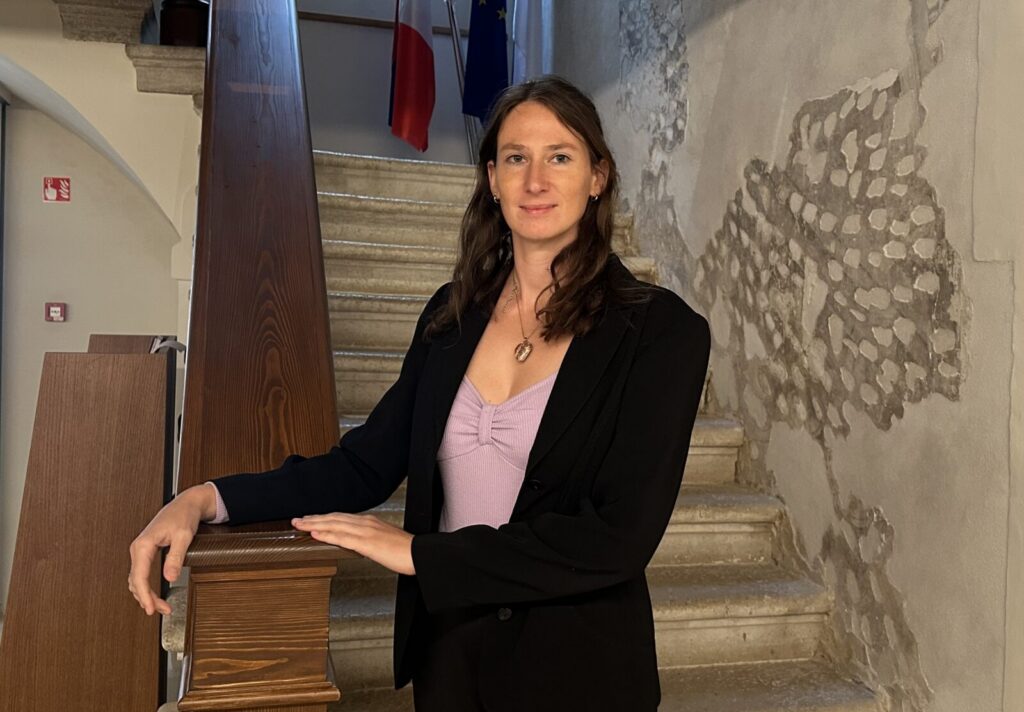
We spoke with Sandra Končan, a researcher at the Institute for Social Studies of the Science and Research Centre Koper (ZRS Koper), about the establishment of Skupnost 4 – a community centre that provides access to information, counselling services and support, primarily for women with a migrant background, but also for other local residents. The centre encourages connections with the local community and helps raise awareness about the prevention of exploitation and violence.
As part of the EU co-funded SIS-Hubs project, you opened Skupnost 4 at the Adult Education Centre Koper in October – a space for connection and support within the local community. How did you envision its operation?
We conceived Skupnost 4 as a safe, inclusive and accessible space where women in particular, including those with a migrant background, can seek advice, information about support services and opportunities to connect with the local community. And why the name Skupnost 4? The name carries several meanings: it brings together four areas – social welfare, education, law and healthcare – connects local residents and symbolises the four cardinal directions – north, south, east and west – reflecting the fact that migration takes place from all directions. Everyone who needs support with social integration, access to support services, recognising and preventing violence, legal assistance, non-formal learning or active participation in the local community is welcome, as are professionals working in these fields.
I developed the concept of Skupnost 4 together with my colleague Dr Blaž Lenarčič, in cooperation with the Adult Education Centre Koper. However, the programme will primarily be delivered by female professionals working in the local community in the fields mentioned above, alongside ten female mentors from Belarus, Lithuania, Russia and Ukraine. They will take turns leading weekly group gatherings and, by arrangement, individual consultations. Childcare will also be available during activities, as we want to encourage the participation of mothers and other caregivers. From November this year until June next year, thematic meetings will therefore take place on Friday afternoons at the Adult Education Centre Koper, offering opportunities for informal conversations, information sharing and assistance with potential difficulties. And, fittingly given its name, we have chosen classroom number 4 as the venue for our activities.
Skupnost 4 is therefore primarily intended to foster connections and facilitate the exchange of information about support services. Nevertheless, the project also raises awareness about violence against women.
One of the objectives of the SIS-Hubs project is to raise awareness of different forms of violence against women and human trafficking. To this end, we also cooperate with the Ključ Association. By improving access to information, empowering individuals and strengthening community connections, we aim to contribute to the prevention of exploitation and violence through Skupnost 4. However, the primary purpose of the meetings is to improve access to support services in the local community and facilitate the exchange of information that can be useful in everyday life, both for migrant women and for other local residents.
Do you think that women who need information will find their way to you?
We will do our best to ensure that our meetings are sufficiently visible and accessible. We will therefore promote them through social media, local media outlets and both formal and informal communication channels. With this in mind, we will launch our first event on 6 November, focusing on knowledge sharing and providing further information about Skupnost 4. Our mentors will introduce visitors to our work so far and upcoming activities, as well as key rights and responsibilities, relevant institutions, personal experiences and practical guidance in the fields of social welfare, education, law and healthcare. This will be followed by a participatory activity to develop promotional materials. Invitations to the event will be distributed with the support of the entire project team and the network of governmental and non-governmental organisations.
At the Institute for Social Studies of ZRS Koper, you have already addressed the situation of migrant women through various projects. Their experiences and needs presumably differ depending on their country of origin, educational background and cultural environment. For example, the experience of a highly educated woman arriving in Slovenia from Ukraine may be quite different from that of a woman from Kosovo who, perhaps due to cultural norms, finds it more difficult to establish contacts outside her own community. What has your experience been?
Integration, particularly of women, and interculturality are important research areas at the Institute for Social Studies of ZRS Koper. The needs of migrant women do indeed vary, not only according to their country of origin, level of education and cultural background, but also depending on their employment status, family circumstances and other factors. This is precisely why it is important to pursue an individualised and participatory approach rather than relying on overly general assumptions. Every migrant woman has a unique combination of skills, aspirations, needs and obstacles she faces. Flexibility and an understanding of these individual circumstances are therefore essential to successful integration. A good example of this approach is a Slovenian language course tailored to the needs of specific groups, such as the programme Practical Slovenian for Albanian Speakers (Uporabna slovenščina za albansko govoreče).
In the local community, organisations such as PiNA, the Adult Education Centre Koper, the Morje Multigenerational Centre and others also work with migrants. At the opening of Skupnost 4, you highlighted the importance of cooperation between institutions and organisations, as well as the need to ensure continuity in projects promoting migrant integration. It is often argued that systemic solutions are lacking in this field and that project-based work alone is not sufficient.
Previous projects have already demonstrated the need for stronger connections and cooperation among the various stakeholders in the City Municipality of Koper who work directly or indirectly with migrant women. Cooperation between individual institutions, as well as between local, regional and national levels of decision-making, is essential for successfully addressing integration challenges. If we focus on only one aspect, we will certainly not be able to address the key issues comprehensively, as integration is a complex process. An interdisciplinary approach also contributes to greater long-term sustainability. Particularly in the case of short-term projects, it is beneficial to involve as many stakeholders as possible so that they can continue implementing important project initiatives after the projects have ended. For example, the need for an information point established by the City Municipality of Koper has also become apparent, as a similar initiative in Ankaran has proved successful.
You cooperate with several international partners in the SIS-Hubs project. What are the benefits of this type of international cooperation?
International cooperation contributes to a better understanding of the European context of migration issues and efforts to combat gender-based violence. It also allows us to draw on research and good practices from other countries. However, we must not forget that every local environment has its own characteristics, needs and challenges. This is why, when implementing activities, we focus precisely on these aspects – the needs of each individual local community. •
AUTHOR: Nataša Čepar, ZRS Koper
The project SIS-hubs (Sorority, Integration and Support for women and girls through community-based programmes), AMIF-2024-TF2-AG-THB, project number: 101198346, led at ZRS Koper by Sandra Končan, is co-funded by the European Union. The views and opinions expressed in this article are those of the authors only and do not necessarily reflect those of the European Union or the European Commission. Neither the European Union nor the European Commission can be held responsible for them.