 en
 Slovenščina
 Italiano
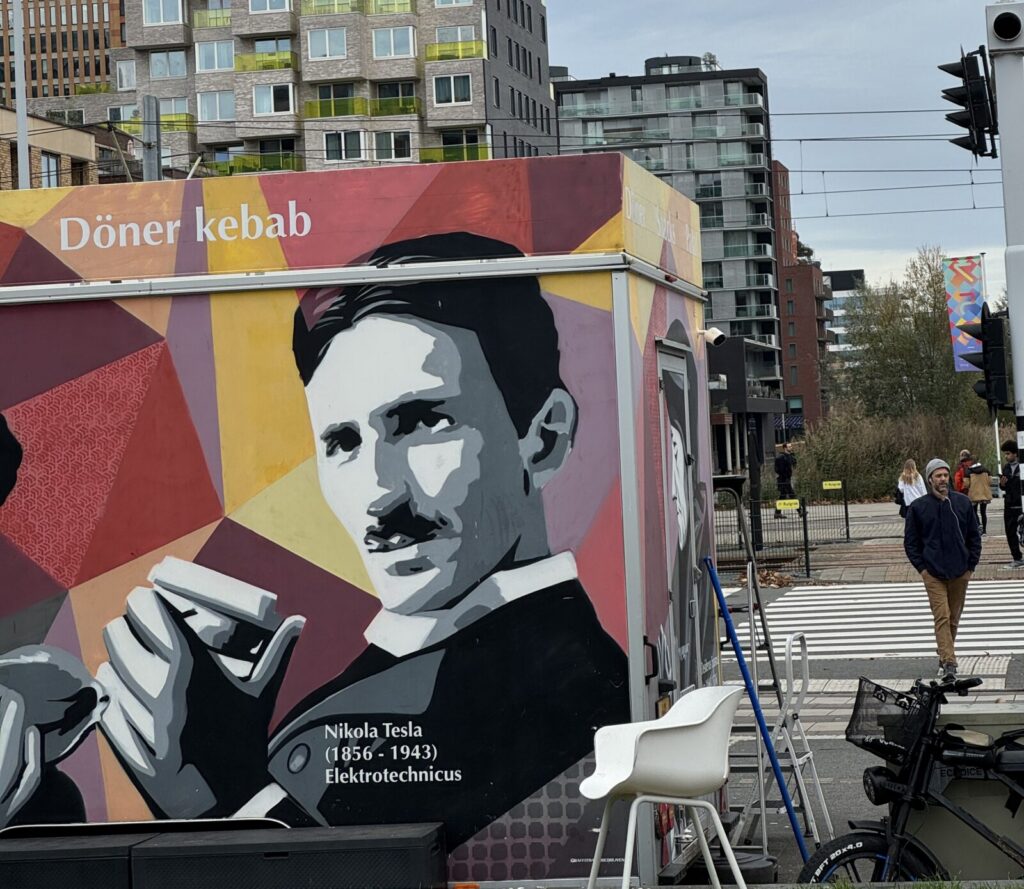
What can we learn from the technological revolution of the past – the equally disruptive electrical revolution, at the heart of which stood the inventor, scientist and visionary Nikola Tesla (1856–1943) – as we experience today’s technological revolution driven by artificial intelligence (AI)? Lessons from history are sometimes more direct, sometimes less so. In the case of the electrical revolution, certain parallels with the current technological revolution are both interesting and instructive.
We are experiencing the growing influence of AI in every aspect of society: culture, entertainment, media, the economy, energy, education, politics and even personal relationships. We are living through a technological revolution whose outcome is difficult to predict. According to experts, we are still in the early stages of the transformation of the world brought about by AI, although the future of an AI-driven society is not predetermined.
Compared with the AI revolution, our understanding of the electrical revolution of the late 19th and early 20th centuries benefits greatly from historical distance and the opportunity to study its context, consequences, guiding ideas and development. Economic historians emphasise that profound changes in productivity and the organisation of work within companies, and consequently in many other aspects of society, emerged only several decades after Tesla’s and Edison’s inventions and the initial introduction of the new technology. We should therefore expect a similar delay with artificial intelligence, although it is likely to be shorter in this case. Nevertheless, major transformations of the economy, work and social practices are probably still to come, and they are spreading very unevenly.
Ideological differences between key figures are also relevant, as are the relationships between visions of the world and technology on the one hand, and the actual development of technological society on the other. In this respect, the parallels are both interesting and instructive. Both revolutions involve a tension between two opposing approaches: techno-scientific optimism, accompanied by a moral vision of human and sustainable progress, and aggressive experimentation with new technology aimed at achieving market dominance and power, with little or no ethical consideration.
For Tesla, corporate profitability was an unavoidable reality of the capitalist system, but his inventions, underpinned by extensive theoretical research, were driven by an ambitious moral vision: technology should serve the good of humanity as a whole and bring humanity into harmony with the environment through greater efficiency. Thomas Edison, Tesla’s rival in the ‘War of the Currents’, primarily followed the ruthless principles of the free market. Through numerous experiments, many of which proved unsuccessful, he occasionally arrived at technological discoveries that enabled him to generate enormous profits and achieve a dominant market position.
In the world of AI, a comparable contrast can be drawn between Demis Hassabis and Sam Altman. The work of Hassabis, an AI pioneer, founder of DeepMind and successful businessman, is driven by a clear vision, whether or not we agree with it: addressing humanity’s and the planet’s greatest challenges (disease, the environmental crisis, energy and poverty) through AI-driven science, within a strict ethical framework. Altman and his company OpenAI, by contrast, develop AI through an aggressive market-driven model: they test AI on millions of ChatGPT users. This ethically questionable and dangerous strategy has brought the company billions of dollars, market dominance and exceptional political influence.
Capitalism, combined with weak or non-existent ethical and legal oversight, rewards the Edisons and Altmans of this world far more generously than the Teslas and Hassabises. The shape of the future AI-driven society will also depend on the extent to which we bring AI companies under ethical and legal regulation, and on the political determination to achieve this.
AUTHOR: Dr Gorazd Andrejč, Institute for Philosophical and Religious Studies, ZRS Koper
The research work carried out within the project Nikprojectola Tesla: Philosophy of Energy, Technology, and Religion and Its Relevance Today (J7-60133) is funded by the Slovenian Research and Innovation Agency (ARIS).