en
en Slovenščina
 Italiano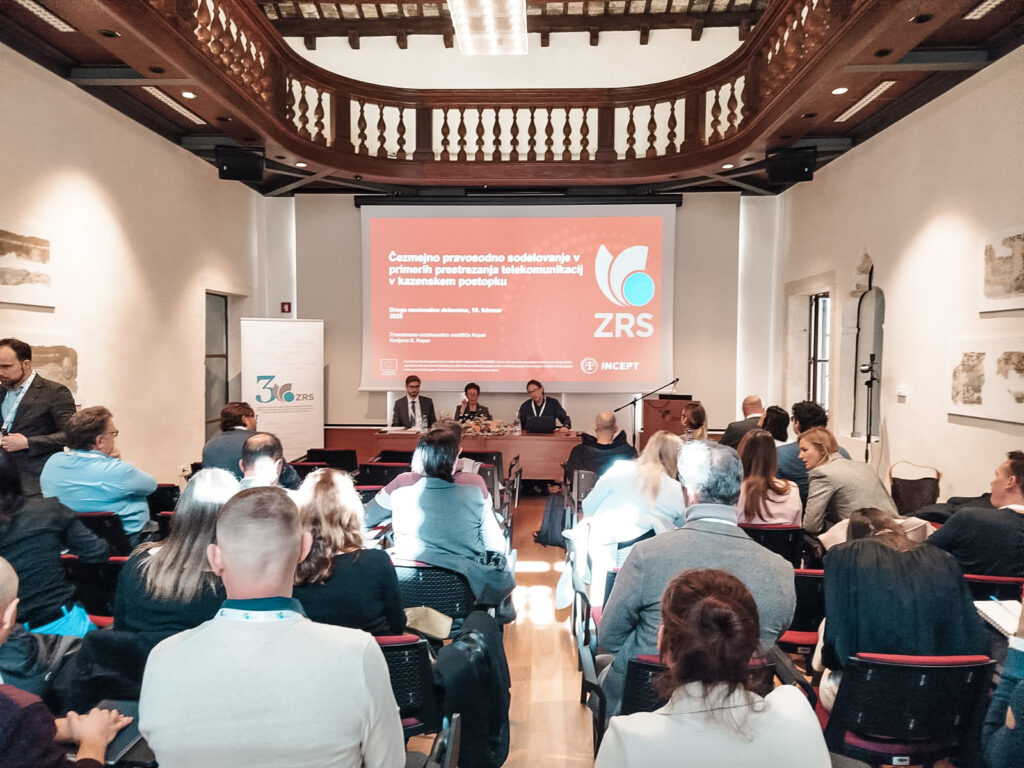
The Science and Research Centre Koper (ZRS Koper) successfully held the second national workshop titled Cross-Border Judicial Cooperation in Telecommunications Interception Cases in Criminal Proceedings on February 19, 2026, within the framework of the INCEPT project. The workshop, which took place at the Centre for Humanities of ZRS Koper, was attended by around 40 representatives from the judiciary, law enforcement, the legal profession, and the wider expert community.
With this workshop, ZRS Koper concludes a series of national meetings dedicated to discussing the challenges of cross-border evidence gathering, particularly in the context of telecommunications interception and the implementation of the European Investigation Order (EIO). Both workshops were very well received by participants and were evaluated as highly useful for exchanging experiences and strengthening interinstitutional cooperation.
The workshop was organized as part of the INCEPT project (Supporting Cross-Border Judicial Cooperation in Cases Related to Interception of Telecommunications), funded by the European Commission under the JUST programme and implemented by a consortium of research organizations from Bulgaria, Poland, the Czech Republic, and Slovenia.
The event was opened by Dr. Tilen Glavina, Deputy Director of ZRS Koper; Bogdan Petrov, representative of the Law and Internet Foundation (Sofia); and Dr. Benjamin Flander, Head of the INCEPT project team.
The first panel addressed evidence gathering through telecommunications surveillance in the EU, focusing on Slovenian legislation, case law, and the European legal framework, including judgments of the European Court of Human Rights and the Court of Justice of the European Union. The panel was moderated by Dr. Flander.
The second panel focused on the European Investigation Order (EIO) and cross-border telecommunications surveillance in practice. Lea Dukič Japelj from the District Court in Koper and Matevž Brus from the District State Prosecutor’s Office in Ljubljana discussed the issuing and execution of EIOs, as well as challenges arising from differing legal frameworks across Member States. The panel was also moderated by Dr. Flander.
The third panel addressed the technical and technological aspects of telecommunications surveillance. Expert Miran Kimovec presented practical challenges in cooperation between judicial authorities and telecommunications operators.
The fourth panel focused on the role of Eurojust in cross-border evidence gathering, with an emphasis on the EIO. The presentation was delivered remotely by Boštjan Škrlec, Slovenia’s National Member at Eurojust.
The workshop concluded with a round table on the challenges of cross-border evidence gathering through telecommunications surveillance, featuring experts from the judiciary, police, and legal profession. Participants included Anja Štrovs from the District Court Koper, Ivan Pridigar from the Specialized State Prosecutor’s Office, Marko Krajnc from the Criminal Police Directorate of the General Police Administration, and attorney Antonio Novak from the law firm Martinčič Novak. The discussion was moderated by District Judge Martin Jančar.
The workshop provided participants with valuable insights into the legal, technical, and operational aspects of cross-border telecommunications surveillance and strengthened cooperation among stakeholders in criminal justice.
In the next phase of the project, a practical handbook on cross-border cooperation in telecommunications interception cases will be developed to support participants in their future work. Representatives of the judiciary, law enforcement, the legal profession, and the expert community, together with ZRS Koper representatives, will also take part in an international meeting in Poznań, Poland, which will offer an opportunity to further deepen discussions and strengthen international cooperation.
The views and opinions expressed in this article are solely those of the authors and do not necessarily reflect the views of the European Union or the European Commission. Neither the European Union nor the European Commission can be held responsible for the content.