en
en Slovenščina
 Italiano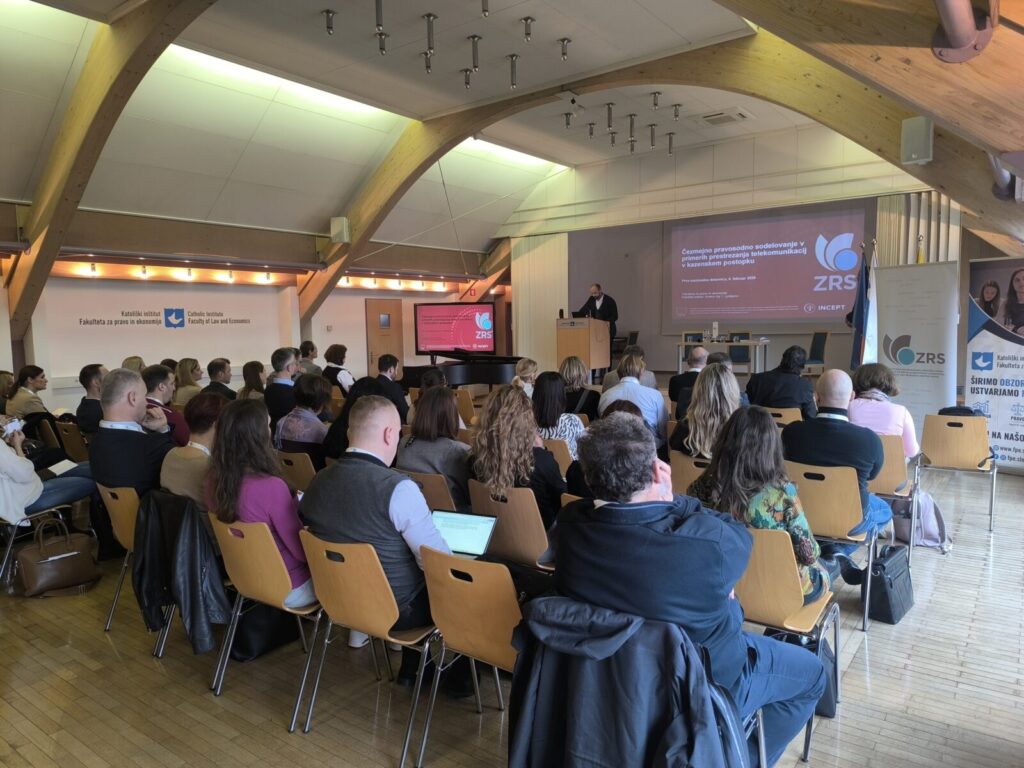
On Thursday, February 6, 2026, the first national workshop titled Cross-Border Judicial Cooperation in Telecommunications Interception Cases in Criminal Proceedings took place at the UL Faculty of Law and Economics of the Catholic Institute in Ljubljana. The workshop was organized by ZRS Koper within the framework of the INCEPT project (Supporting Cross-Border Judicial Cooperation in Cases Related to Interception of Telecommunications), funded by the European Commission under the JUST programme and implemented by a consortium of research organizations from four countries (Slovenia, Bulgaria, Poland, and the Czech Republic). The project aims to strengthen cross-border judicial cooperation in criminal proceedings, with a particular focus on the implementation of the European Investigation Order (EIO) in cases involving telecommunications interception.
The event was attended by approximately 50 representatives of the judiciary, law enforcement, the legal profession, and the wider expert community. The participants were welcomed by the Deputy Director of ZRS Koper, Dr. Tilen Glavina, who emphasized that ZRS Koper actively promotes dialogue among different stakeholders in criminal justice. This very dialogue was also enabled through the national workshop, which brought together judges, prosecutors, police officers, lawyers, and other experts to discuss the challenges of cross-border evidence gathering.
Participants were also addressed via video link by Prof. Dr. Daniela Ilieva, Executive Director of the Law and Internet Foundation in Sofia and project coordinator. Prof. Ilieva highlighted the importance of trust and cooperation among EU Member States in the use of modern investigative measures.
On behalf of the host institution, the UL Faculty of Law and Economics, participants were welcomed by Dean Assoc. Prof. Dr. Mitja Steinbacher. The organizers would like to sincerely thank the Dean and the Faculty for kindly providing the venue and enabling the event to take place in a stimulating academic environment.
In the opening session, the head of the ZRS Koper project team, Assoc. Prof. Dr. Benjamin Flander, pointed out that one of the consequences of the “new digital reality” in criminal law and criminal justice is that “in approximately 90% of cases, criminal prosecution is based on electronic evidence. Among these, communication data play a particularly important role in the effective prosecution of organized crime. The number of requests to telecommunications service providers and information society service providers has increased significantly (reportedly tripling over the past five years). Nevertheless, many criminal investigations are delayed or unsuccessful due to difficulties in accessing data or evidence of suspects’ communications.”
According to Dr. Flander, this is partly due to insufficient engagement and technological barriers (such as inadequate technical equipment for interception) in some Member States. He also highlighted the shift from traditional telephony and SMS messaging to OTT messaging applications (which are estimated to account for around 97% of remote communication), enabling so-called end-to-end encryption. “While this is positive for communication privacy, it has significantly reduced the effectiveness of lawful interception and, consequently, the prosecution of organized crime,” Dr. Flander added. He further noted that the emergence of encrypted communication networks (e.g. EncroChat and Sky ECC) presents an additional challenge.